
This post may contain affiliate links, please read my full disclosure policy for more details.
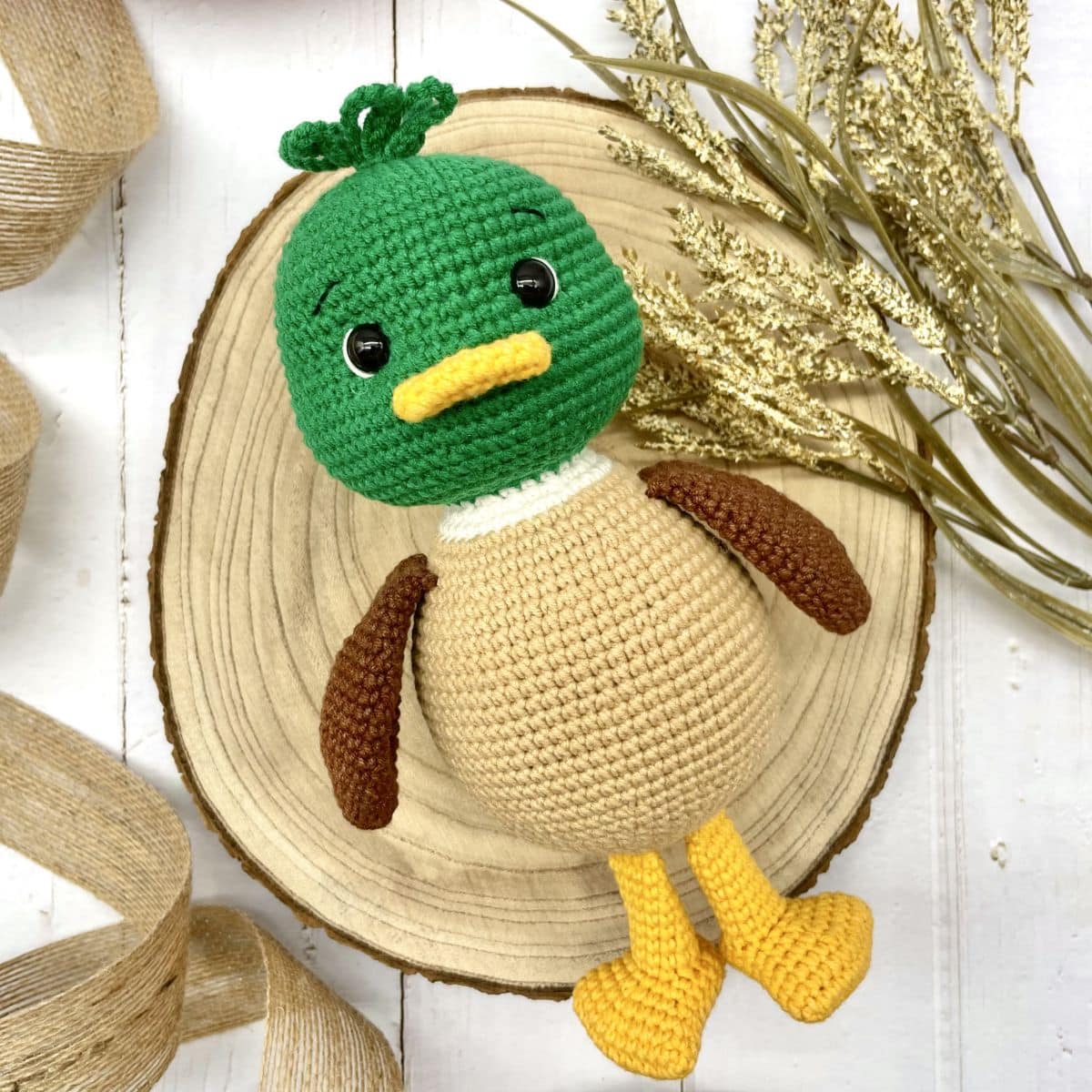
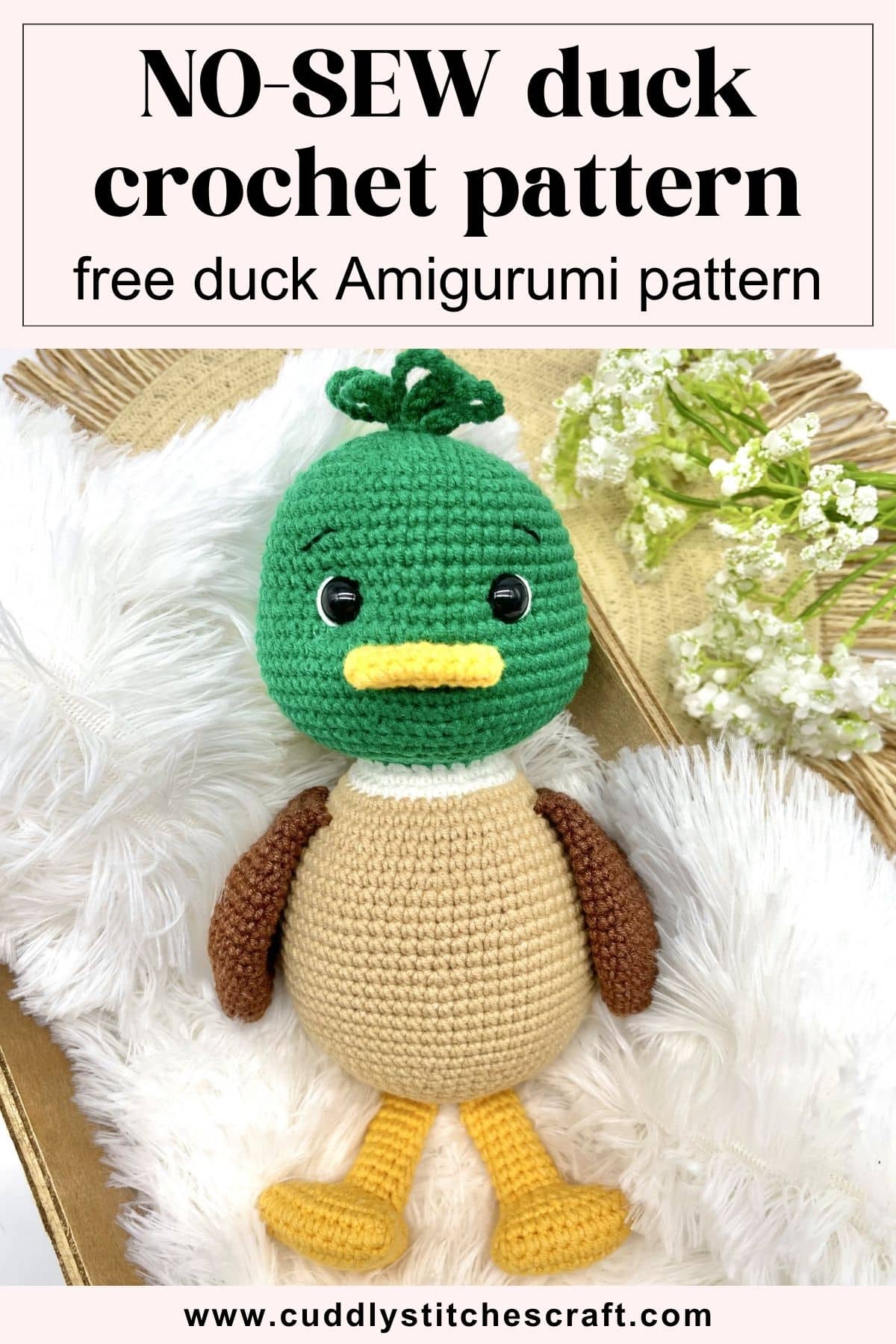
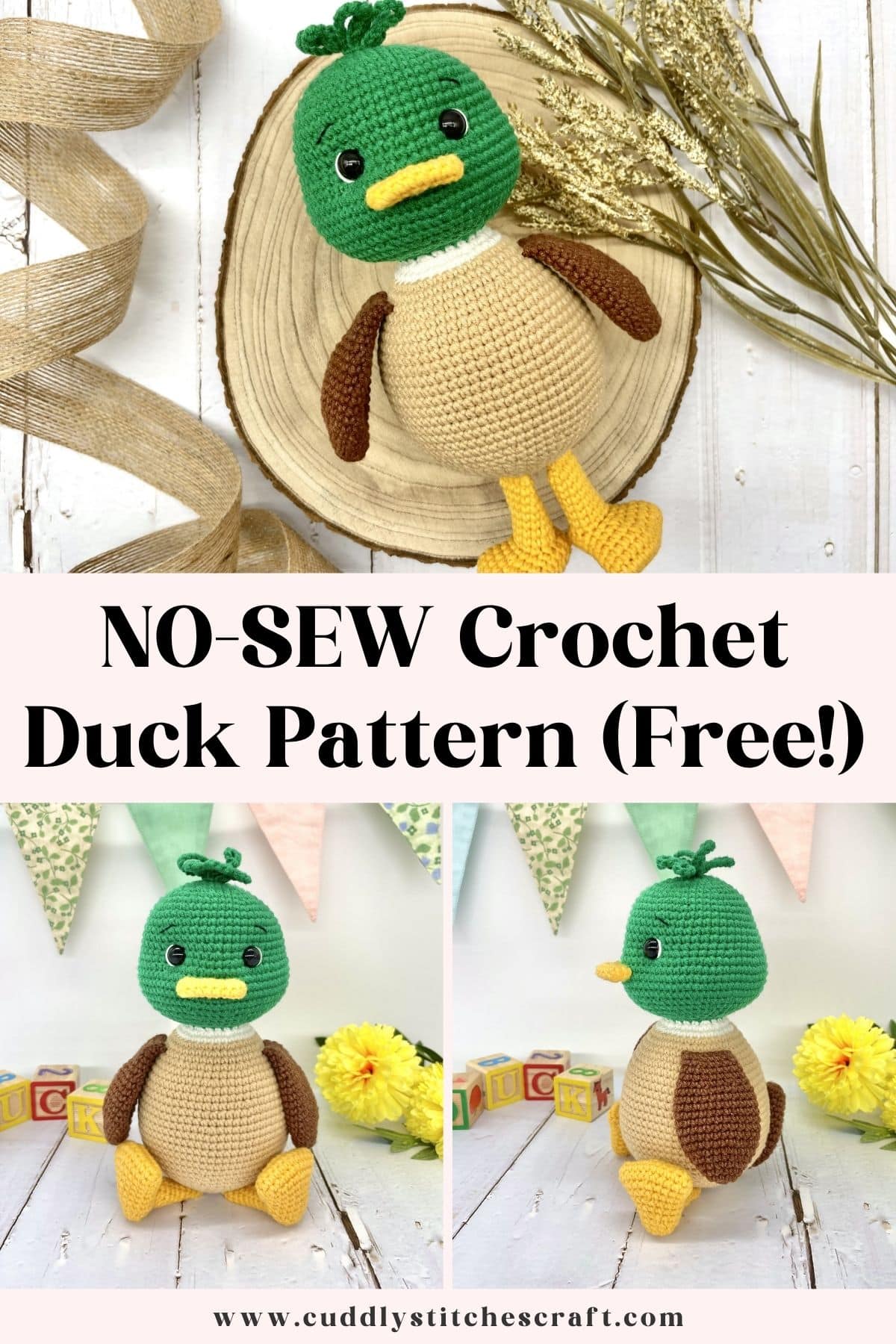
This cute crochet duck first made an appearance in my mystery Amigurumi crochet along and it quickly became a favorite. If you’ve been looking for a free duck crochet pattern, I think you’ll enjoy crocheting this one. It’s fun to make and packed with plenty of character.
This crochet mallard duck is completely no-sew, which means no body parts waiting to be stitched together at the end. It’s an easy and relaxing crochet project that’s suitable for confident beginners and experienced crocheters alike.
If you’ve never made an Amigurumi duck before, don’t worry. I’ve included lots of video tutorials throughout the pattern to help you learn how to crochet a duck and guide you through the parts that can sometimes be a little fiddly.
Why You Will Love this Pattern!
- No-sew: no sewing required to assemble your toy
- All you need to know is basic crochet stitches
- Works great with a variety of different yarns including worsted weight yarn
- Easy-to-follow instructions with step by step photos
- Includes detailed video tutorials for extra help
- I’m always happy to provide support with this pattern
- And more importantly…you will have fun making a beautiful gift for your little one or family and friends
Scroll down to view the full written pattern. Or purchase the ad-free printable PDF on Etsy or Ravelry.
How to Crochet a Duck
– This duck crochet pattern (free) is worked in continuous rounds so no need to slip stitch to join the rounds. This way you will avoid having a visible seem on your crochet toy.
– Use a stitch marker to mark the beginning of each round.
– All stitches are worked in both loops unless stated otherwise.
– I always recommend using the invisible decrease that will give you a nicer finish without visible bumps and gaps.
– Always use a crochet hook at least one size smaller than the size recommended on the yarn label to avoid large gaps and the stuffing showing.
– This free crochet duck pattern requires no sewing at all, as every piece is crocheted on, making it an easy and enjoyable crochet project to finish.
– The use of safety eyes or buttons poses a choking risk for children under the age of 3 therefore I recommend using embroidery instead.
– Explore my YouTube channel for more Amigurumi tips and tricks
Get Started with this Duck Crochet Pattern
Pattern Notes
Skill level: intermediate crochet skills and knowledge
Finished size – using 2.5 mm crochet hook (B/1) and Sport weight yarn (4ply #2):
- seated: 18cm (7″)
- standing: 23cm (9″)
Pattern Gauge
Flat crochet circle 2 inches (5 cm) in diameter:
– when using 2.5 mm hook (B/1) and Sport weight yarn (4ply #2)
– 7 rounds with 42 stitches in the last round
Pattern for gauge:
R1: MR – 6 x SC into the ring {6}
R2: INC in each ST around {12}
R3: (SC in next ST, INC) x 6 {18}
R4: SC in next ST, INC, (SC in next 2 STs, INC) x 5, SC in next ST {24}
R5: (SC in next 3 STs, INC) x 6 {30}
R6: SC in next 2 STs, INC, (SC in next 4 STs, INC) x 5, SC in next 2 STs {36}
R7: (SC in next 5 STs, INC) x 6 {42}
Best Yarn for Amigurumi – Get the Free Guide Now!
Sign up for my newsletter and receive the free guide straight into your inbox. Plus stay in the loop with updates on new designs, tutorials and special offers.
Yarn Requirements
This easy crochet duck pattern will work great with the below yarns.
- 100% cotton yarn, 100% acrylic yarn or a blend of cotton and acrylic
- Sport weight yarn (4ply #2)
- Light worsted weight yarn (DK #3)
- Worsted weight yarn (Aran #4)
- Plush yarn/velvet yarn (Bulky #5)
Yarn I used for this crochet duck pattern:
- Sport weight yarn (4ply #2)
- 55% cotton and 45% acrylic blend
- Green yarn – YarnArt Jeans – color 52 – (50g/160m)
- Beige yarn – YarnArt Jeans – color 07 – (50g/160m)
- Dark brown yarn – YarnArt Jeans – color 70 – (50g/160m)
- Orange yarn – YarnArt Jeans – color 35 – (50g/160m)
- White yarn – YarnArt Jeans – color 62 – (50g/160m)
Yardage – when using 2.5mm or B/1 crochet hook and Sport weight yarn (4ply #2):
- Green yarn – approx 17g (54m = 59yds)
- Beige yarn – approx 23g (74m = 81yds)
- Dark brown yarn – approx 12g (38m = 42yds)
- Orange yarn – approx 9g (29m = 32yds)
- White yarn – approx 2g (6.5m = 7yds)
Yarn Substitutes
US Suppliers:
Sport weight yarn (4ply #2):
- 100% cotton: Schachenmayr Pyramid Cotton
- blend of cotton/acrylic: WeCrochet Comfy
Light worsted weight yarn (DK #3):
- 100% cotton:: WeCrochet Animation DK
- blend of cotton/acrylic: Sirdar Stories DK
Worsted weight yarn (Aran #4):
- 100% acrylic: Universal Yarn Uptown
- 100% acrylic: WeCrochet Brava
UK Suppliers:
Sport weight yarn (4ply #2):
- 100% cotton: Scheepjes Catona
- 100% cotton: Paintbox Yarns Cotton
Light worsted weight yarn (DK #3):
- 100% cotton: Paintbox Yarns Cotton DK
- blend of cotton/acrylic: Paintbox Yarns Cotton Mix DK
Worsted weight yarn (Aran #4):
- 100% acrylic: Universal Yarn Uptown
- 100% acrylic: Scheepjes Chunky Monkey
If you would like to check some more substitutes for YarnArt Jeans then have a read of my Best Yarn for Amigurumi Crochet tutorial. You can find the substitutes towards the end of the article.
Materials and Equipment
Materials needed:
- a long strand of white yarn – about 30cm (12″)
- a long strand of black thread embroidery yarn – about 30cm (12″)
- polyester fibre fill
Crochet hook size:
- 2.5 mm crochet hook (B-1) for Sport weight yarn (4ply #2)
- 3 mm crochet hook (C-2) for Light worsted weight yarn (DK #3)
- 3.5 mm crochet hook (E-4) for Worsted weight yarn (Aran #4)
- if using a different weight of yarn then refer to the hook size recommendations on the yarn label but use a smaller hook – go at least one size smaller
I highly recommend this ergonomic crochet hooks set from Amazon as it comes in a stylish case and with other handy accessories such as stitch markers etc.
Other equipment needed:
- scissors
- tapestry needle/yarn needle
- pins with large heads
- stitch marker
- 10mm safety eyes – when using Sport weight yarn (4ply #2)
- 12mm safety eyes – when using Light worsted weight yarn (DK #3) or Worsted weight yarn (Aran #4)
Complete the Flock
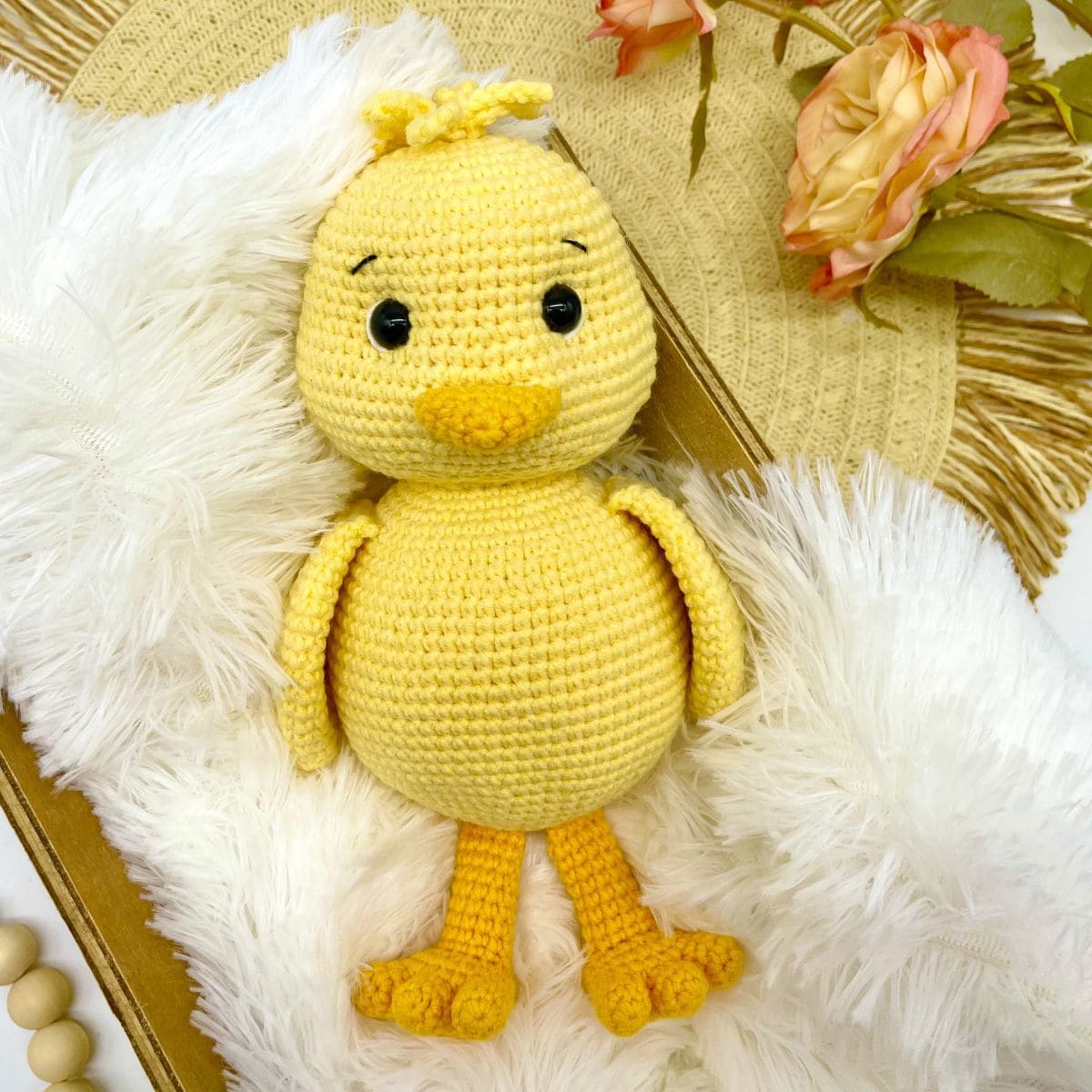
This adorable crochet duck pairs perfectly with my crochet chicken. Crochet both to create a charming farmyard duo!
Pattern Abbreviations
This duck crochet pattern (free pattern) is written using US crochet terms.
MR: magic ring/magic circle
CH: chain
SL ST: slip stitch
ST: stitch
SC: single crochet stitch
INC: increase = two single crochet stitches in the same stitch
INV DEC: invisible decrease = insert the hook into the front loop of the first stitch (two loops on hook) and immediately insert it again into the front loop of the next stitch (three loops on the hook). Yarn over and draw through the first two loops on the hook (two loops on the hook). Yarn over and draw through the two loops on the hook to finish your invisible decrease
BLO: back loop only
FL ST: front loop stitch
FO: fasten off
INV FO: invisible fasten off
(…..) x 6: repeat the pattern inside the brackets by the given number (in this example, repeat the pattern in the brackets 6 times)
{…}: number shown inside these brackets equals the number of stitches at the end of each round
Special Stitches
INV DEC = invisible decrease:
- insert hook into the front loop of the next stitch
- then insert your hook into the front loop of the following stitch
- yarn over and draw through the first two loops on the hook (two loops left on the hook)
- yarn over and draw through the remaining two loops on the hook to finish your invisible decrease
Video Tutorials
If it is your first time dipping your toes in the world of Amigurumi, then you may find these Amigurumi tutorials handy before you get started with this free Amigurumi pattern.
And don’t forget to watch my step-by-step video tutorials for extra help with my free crochet patterns. Many of my videos also have a left handed version available.
Need Help with this Amigurumi Duck Pattern?
The fastest way to get help with this crochet duck free pattern is to leave your question in the comment box at the bottom of this post.
Or join our Cuddly Stitches Community Facebook group to ask for support with this pattern. Many of the members have experience with my patterns and will be more than happy to help. You can also share your creations, chat to fellow Amigurumi makers or exchange tips and tricks.
Cuddly Stitches Community
Join thousands of other Amigurumi crocheters in our community. Get help with your projects, show off your creations and share helpful tips and tricks.
How to Download My Amigurumi Patterns
My free Amigurumi patterns are supported by ads on this website and are not downloadable or printable. But you can download the ad-free PDF pattern for a small fee from my Etsy store or Ravelry shop.
Your generous contribution will help towards the cost of materials and running this website. So I can continue to publish my free online patterns on this blog for everyone to enjoy.
Printable Duck Crochet Pattern
Purchase the ad-free PDF pattern with easy to follow instructions and extra photos.
Just want the free option? Keep scrolling!
Duck Crochet Pattern: Step by Step
You can find the free crochet pattern below. I have included lots of photos to make it easier for you to follow the detailed instructions. Some sections of the pattern also include step-by-step video tutorials needed for that specific part of the pattern.
Wings
Yarn color: dark brown
Construction: crochet from the bottom of the wing upwards
Make two wings
R1: MR – 6 x SC into the ring {6} – watch this video tutorial on How to crochet a magic ring
R2: INC in each ST around {12}
R3: SC in each ST around {12}
R4: (SC in next ST, INC) x 6 {18}
R5: SC in each ST around {18}
R6: SC in next ST, INC, (SC in next 2 STs, INC) x 5, SC in next ST {24}
R7-R14 (8 rounds): SC in each ST around {24}
R15: SC in next ST, INV DEC, (SC in next 2 STs, INV DEC) x 5, SC in next ST {18} – watch this video tutorial on How to crochet an invisible decrease
R16-R17 (2 rounds): SC in each ST around {18}
R18: SC in next 2 STs, INV DEC, (SC in next 4 STs, INV DEC) x 2, SC in next 2 STs {15}
R19: SC in each ST around {15}
R20: SC the opening together to close the wing, do not stuff {7} – watch this video tutorial on How to close a hole in a flat Amigurumi piece
FO and weave the yarn tail in
Mystery Crochet Along
Join our free crochet along and unravel the mystery as you stitch along with other fellow crocheters.
Feet
Yarn color: orange
Construction: crochet from the front of the foot towards the heel
Make two feet
R1: Chain 12 STs {12} – watch this video tutorial on How to crochet Amigurumi around a foundation chain to help out with R1 to R2 – the video starts with a different number of chains but the technique is the same
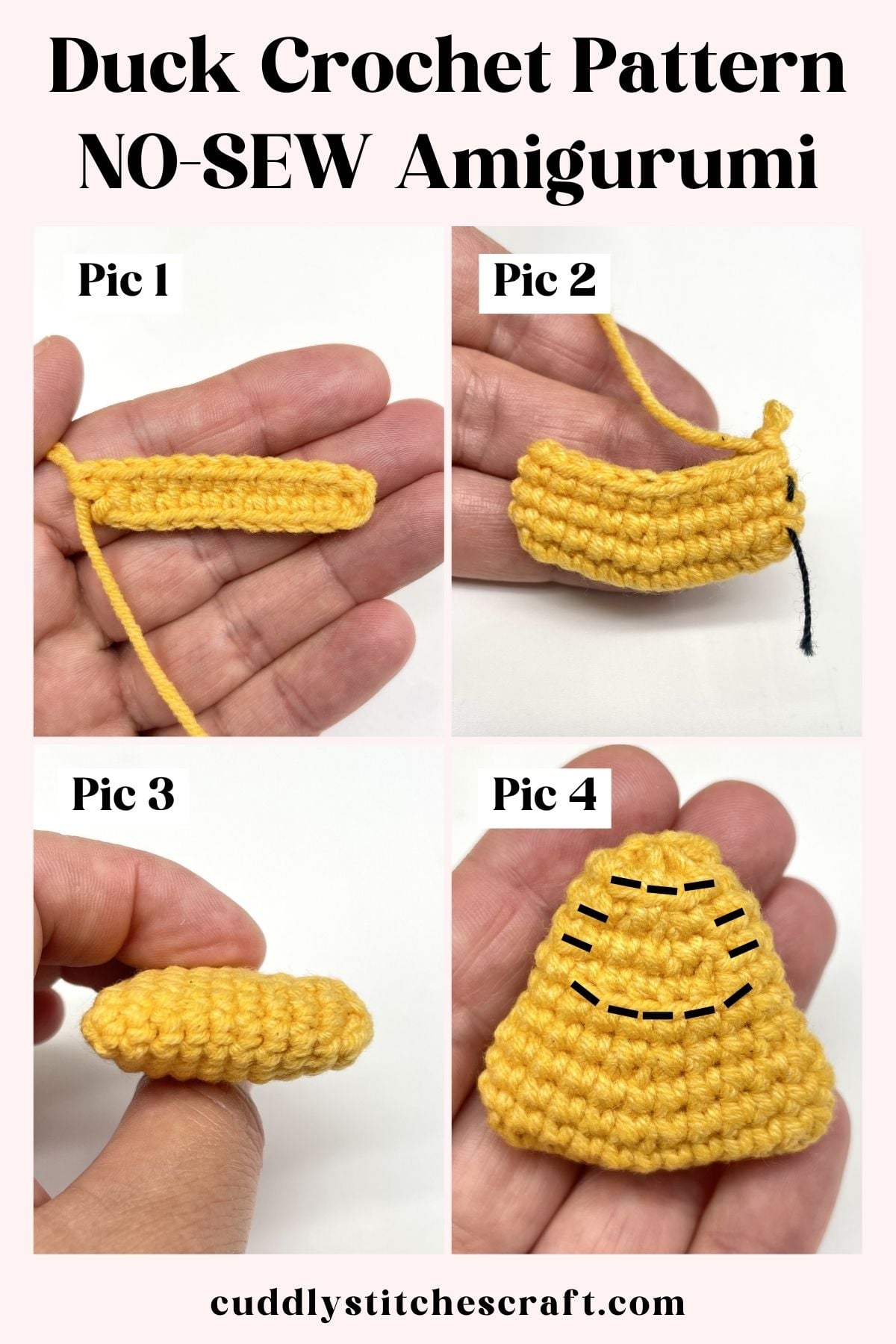
R2: SC in next 11 STs starting from 2nd CH from the hook; go through back bump of each CH as well, now work on the opposite side of the chain, INC in next ST, SC in next 9 STs, INC in last ST {24} (Pic 1)
R3: SC in each ST around {24}
R4: SC in next 5 STs, INV DEC, SC in next 10 STs, INV DEC, SC in next 5 STs {22}
R5: SC in each ST around {22} (Pic 2)
R6: INV DEC, SC in next 3 STs, INV DEC, SC in next 3 STs, INV DEC, SC in next 4 STs, INV DEC, SC in next 4 STs {18}
R7: SC in each ST around {18}
R8: SC in next 2 STs, SC in next 5 STs – BLO, SC in next 11 STs {18}
R9: SC in next ST, SC in next ST – BLO, INV DEC, SC in next 3 STs, SC in next ST – BLO, INV DEC, SC in next 4 STs, INV DEC, SC in next 2 STs {15}
R10: SC in next ST, SC in next ST – BLO, SC in next ST, INV DEC, SC in next ST, SC in next ST – BLO, SC in next ST, INV DEC, SC in next 3 STs, INV DEC {12}
R11: SC in next 2 STs, SC in next 3 STs – BLO, SC in next 7 STs {12} (Pic 3 & 4)
Stuff a little so the foot still stays relatively flat. Close the hole using a tapestry needle and weave the yarn tail in. Watch this video tutorial on How to Close Amigurumi: Ultimate Finish Tutorial
You should have 12 unworked front loop stitches on the top of the foot. You will now continue to crochet the leg into these.
Legs
Yarn color: orange
Construction: crochet the base of the leg into the unworked front loop stitches on top of the foot and then continue to crochet upwards
R1: hold the foot so you are facing the back of it
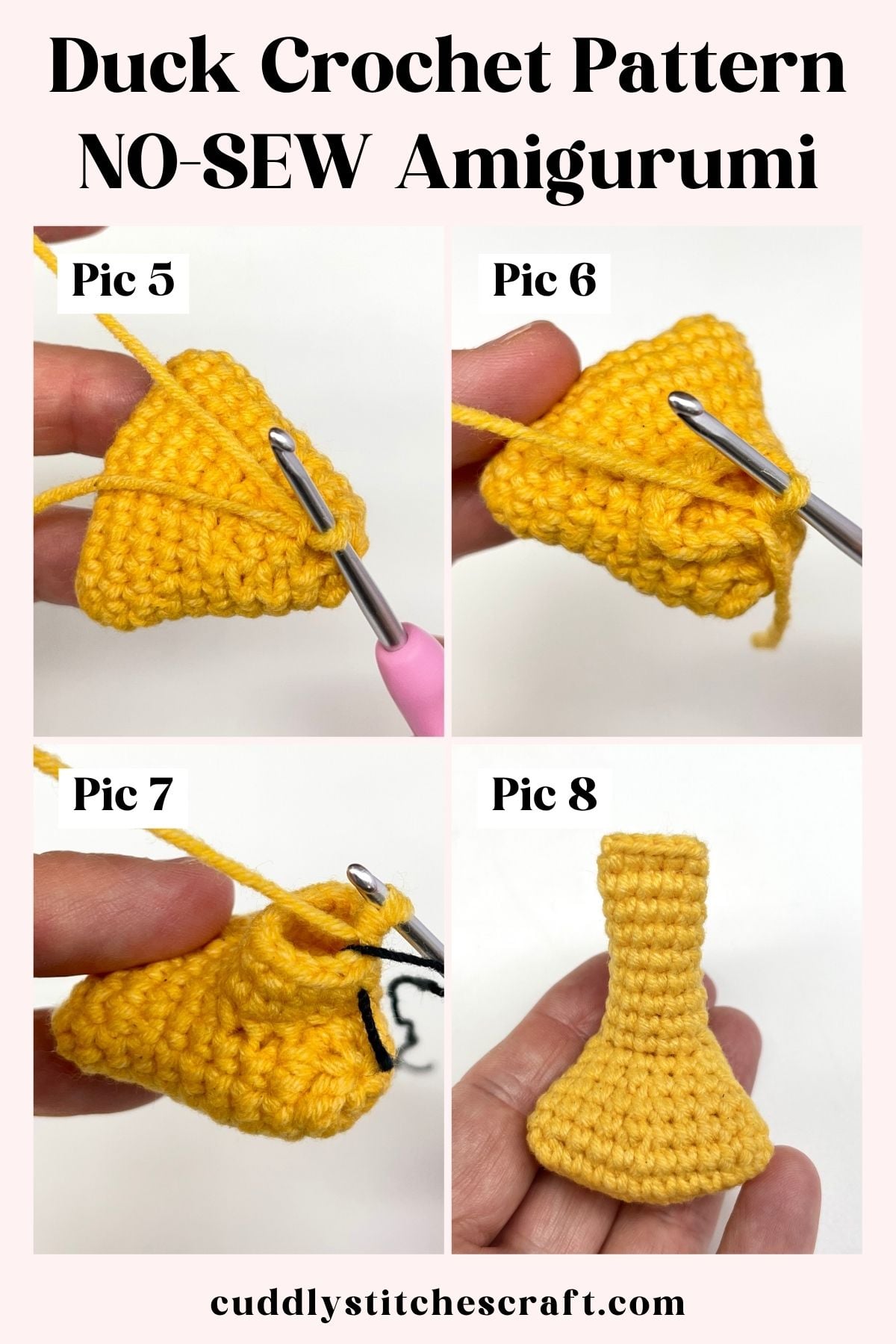
- insert your hook into the middle FL STs in R11, wrap a new strand of yarn around it, pull it through the FL ST (Pic 5) and CH 1x. This will count as your first ST in this round.
- continue to SC in each of the unworked FL STs on the top of the foot to create a round {12} (keep the yarn tail inside the leg). This will be the base of the leg (Pic 6).
R2-R3: (2 rounds): SC in each ST around {12} (Pic 7)
You can now weave the starting yarn tail in
R4: INV DEC, SC in next 10 STs {11}
R5-R6: (2 rounds): SC in each ST around {11}
R7: INV DEC, SC in next 9 STs {10}
R8: SC in each ST around {10}
Stuff the leg half way up
R9: SC in next 4 STs and then SC the opening together to close the leg {4} (Pic 8)
FO and weave the yarn tail in
Bill
Yarn color: orange
Construction: crochet from the front of the bill towards the head
R1: Chain 9 STs {9}
R2: SC in next 8 STs starting from 2nd chain from the hook; go through back bump of each CH as well, now work on the opposite side of the chain, INC in next ST, SC in next 6 STs, INC in last ST {18}
R3: SC in each ST around {18}
R4: SC in next 3 STs, INV DEC, SC in next 7 STs, INV DEC, SC in next 4 STs {16}
Mark the second last ST of R4 with a stitch marker as you will need to refer to it later on.
INV FO, do not stuff, weave the yarn end in – watch this video tutorial on How to crochet invisible fasten off
Explore My Popular Pattern Bundles!
Get Lifetime Access to All Patterns!
Don’t miss out on this fantastic offer! Get unlimited access to all of my printable crochet patterns.
Head
Yarn color: green
Construction: crochet from the top of the head towards the neck
R1: MR – 6 x SC into the ring {6}
R2: INC in each ST around – in BLO {12} – you will have 6 unworked front loop stitches left on the top of the head
R3: (SC in next ST, INC) x 6 {18}
R4: SC in next ST, INC, (SC in next 2 STs, INC) x 5, SC in next ST {24}
R5: (SC in next 3 STs, INC) x 6 {30}
R6: SC in next 2 STs, INC, (SC in next 4 STs, INC) x 5, SC in next 2 STs {36}
R7: (SC in next 5 STs, INC) x 6 {42}
R8: SC in next 3 STs, INC, (SC in next 6 STs, INC) x 5, SC in next 3 STs {48}
R9: (SC in next 15 STs, INC) x 3 {51}
R10-R14 (5 rounds): SC in each ST around {51}
R15: SC in next 8 STs, INC, (SC in next 16 STs, INC) x 2, SC in next 8 STs {54} – leave a stitch marker in at the beginning of R15 as you will need to refer to it later
R16: (SC in next 5 STs, INC) x 9 {63}
R17: SC in next 3 STs, INC, (SC in next 6 STs, INC) x 8, SC in next 3 STs {72}
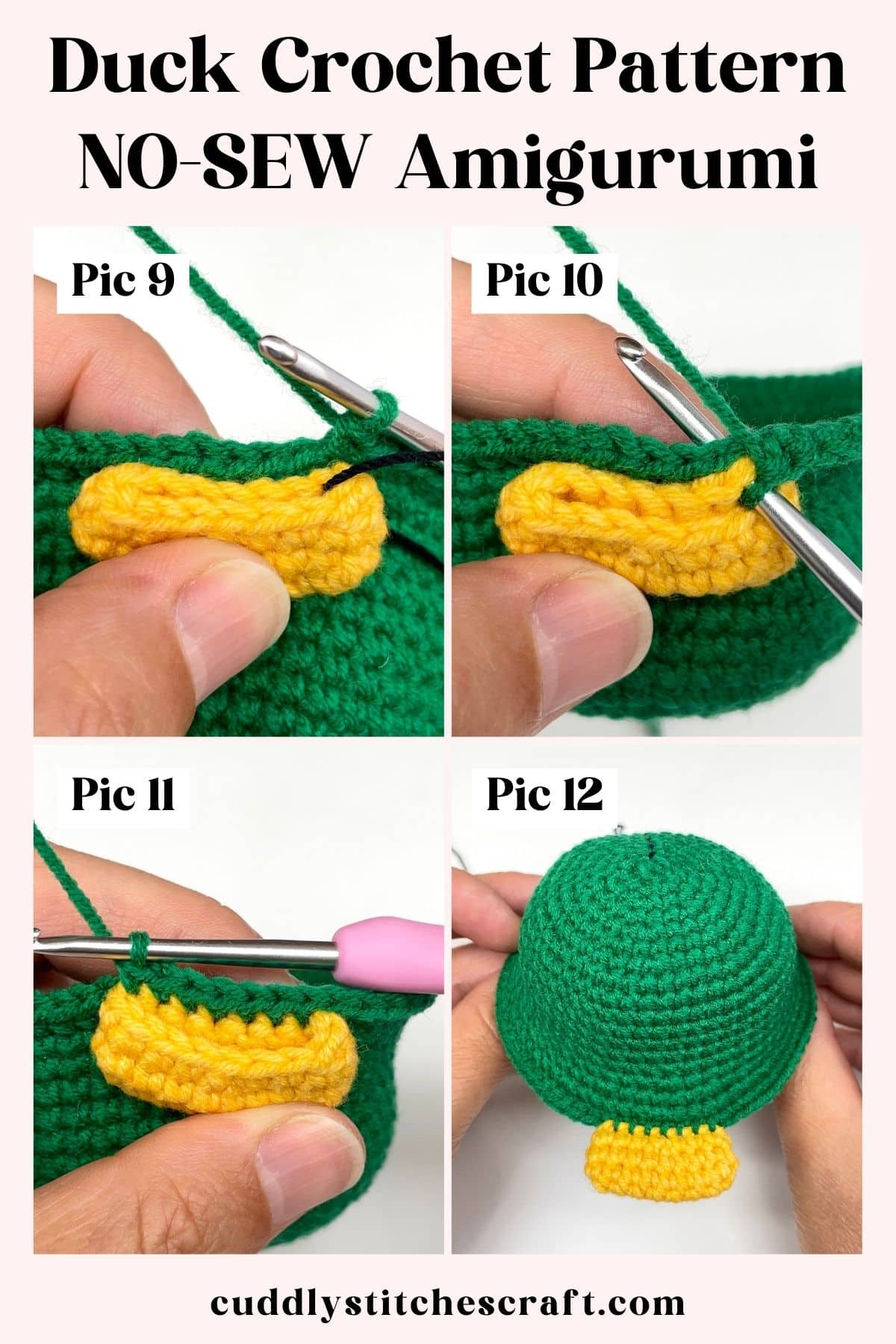
R18: You will attach one half of the bill to the head in this round:
- SC in next 32 STs of the head
- place the bill onto the head making sure the stitch with the stitch marker is on the right hand side (Pic 9)
- insert your hook into the marked ST on the bill and then into the next ST of the head (Pic 10) and SC
- insert your hook into the next ST of the bill and then into the next ST of the head and SC
- continue attaching the bill in the same way across the next 5 STs
- you should now have one half of the bill attached to the head with 7 STs in total (Pic 11)
- continue to SC in next 33 STs of the head only {72} (Pic 12)
R19: You will attach the other half of the bill to the head in this round:
- SC in next 32 STs of the head
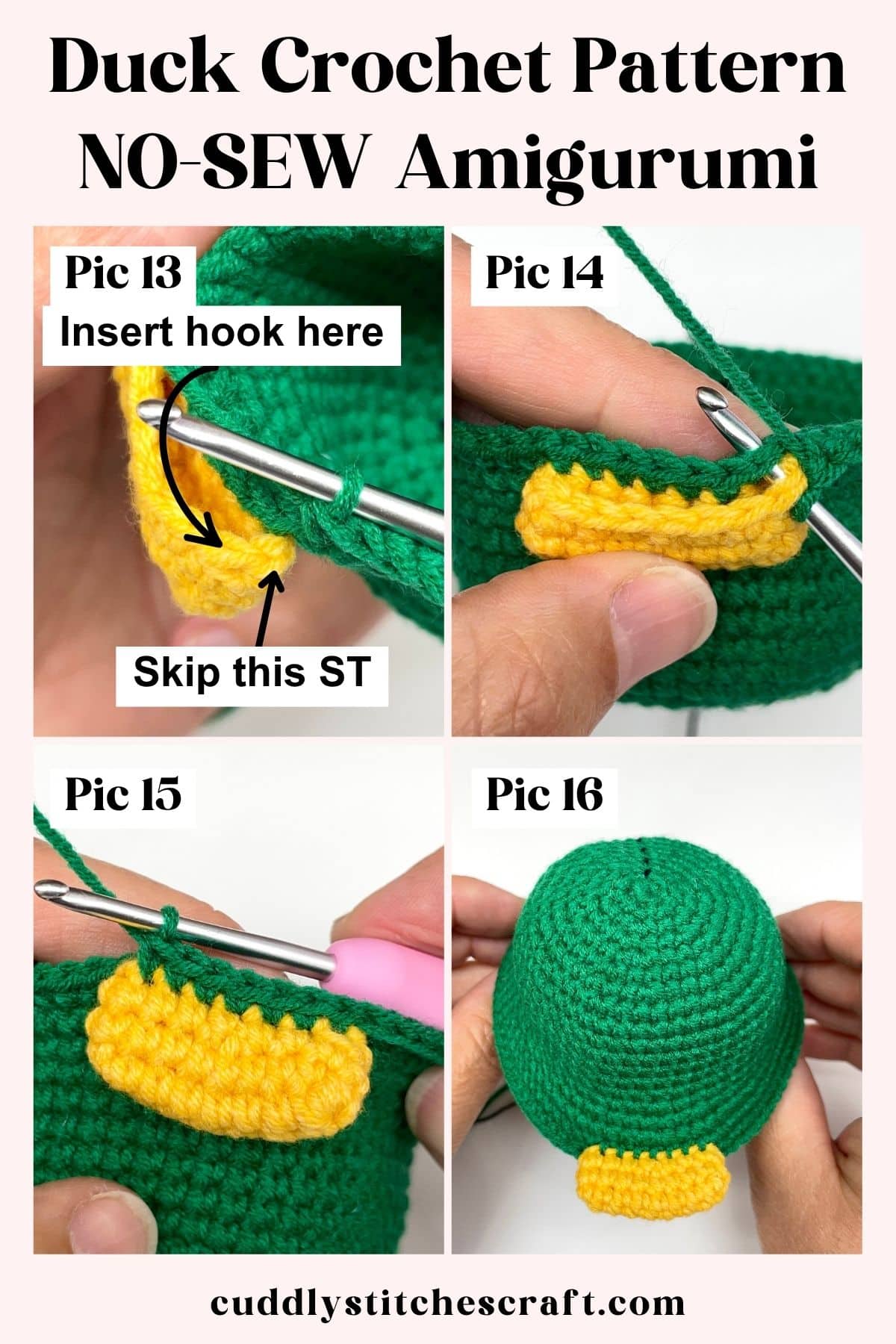
- you need to leave one unworked stitch on the side of the bill so insert your hook into the stitch shown in Pic 13, then insert your hook into the next ST on the head (Pic 14) and SC
- insert your hook into the next ST of the bill and then into the next ST of the head and SC
- continue attaching the bill in the same way across the next 5 STs
- you should now have the other half of the bill attached to the head with 7 STs in total (Pic 15)
- continue to SC in next 33 STs of the head only {72} (Pic 16)
- you should have the bill attached to the head with 1 unworked stitch on each side of the bill
R20-R21 (2 rounds): SC in each ST around {72}
You can now place the safety eyes between rounds R15 and R16:
– it helps to use pins with large heads to first mark the spots where the eyes will be placed – decide if you are happy with the placement and if it looks symmetrical before you insert the safety eyes (Pic 17)
– 1st eye – count first 21 STs from the beginning of R15 and place the eye between ST21 and ST22
– 2nd eye – count first 32 STs from the beginning of R15 and place the eye between ST32 and ST33
– check if you are happy with the look and that the bill is centred between the eyes; adjust the placement of the eyes if necessary
– place the safety backs on and continue to crochet R22
R22: SC in next 2 STs, INV DEC, (SC in next 4 STs, INV DEC) x 11, SC in next 2 STs {60}
R23: SC in next 4 STs, INV DEC, (SC in next 8 STs, INV DEC) x 5, SC in next 4 STs {54}
R24: (SC in next 7 STs, INV DEC) x 6 {48}
R25: SC in next 3 STs, INV DEC, (SC in next 6 STs, INV DEC) x 5, SC in next 3 STs {42}
R26: (SC in next 5 STs, INV DEC) x 6 {36}
Start stuffing the head
R27: (SC in next ST, INV DEC) x 12 {24}
R28: SC in next 3 STs, INV DEC, (SC in next 6 STs, INV DEC) x 2, SC in next 3 STs {21}
Stuff the head well
Do not FO or cut the yarn off as you will continue to crochet the body from here
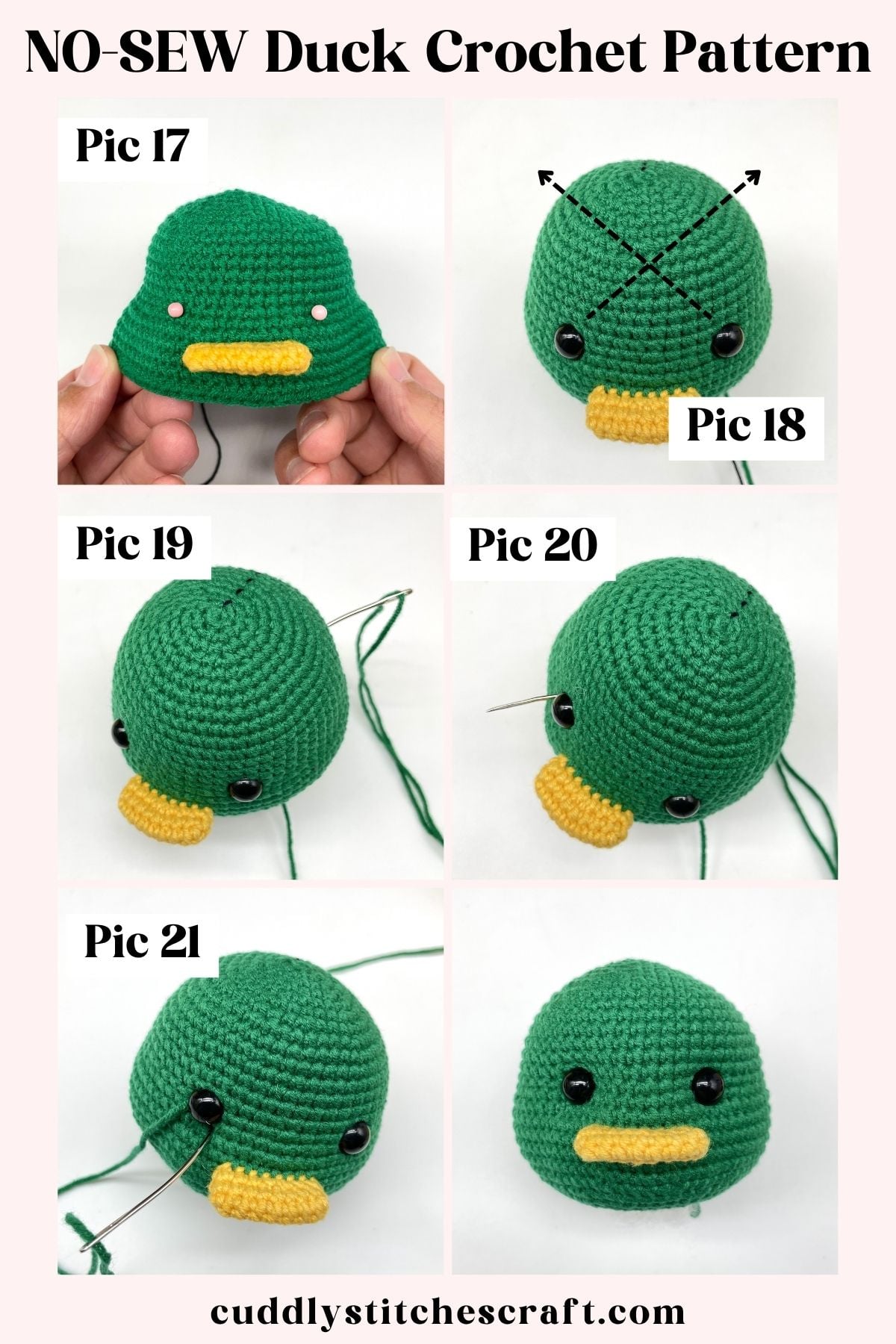
You can now sculpt the eyes (indented eye look):
– watch this video tutorial on How to indent eyes in Amigurumi – use method 2 shown in the video, but instead of sculpting from eye to eye, sculpt each eye individually by pulling it diagonally towards the back of the head (Pic 18)
– insert your needle into any ST on the back of the head (Pic 19) and bring it out through a ST right next to the eye (Pic 20). Leave a long tail at the back of the head.
– if the safety backing makes this difficult, bring the needle out slightly away from the eye, then insert it closer to the eye as shown in the video
– insert the needle into another ST next to the eye (Pic 21), then bring it back out through the same ST on the back of the head. Pull the yarn tight.
– repeat the previous steps until you achieve the desired indented look. Always insert and exit through the same ST on the back of the head.
– to finish, bring the needle out through the same ST on the back of the head, tie the yarn tails into a double knot, then pull the knot inside the head through the same ST.
– repeat for the other eye
– if the back of the head loses its shape after sculpting, add extra stuffing to reshape it
Tail
Yarn color: dark brown
Construction: crochet from the tip of the tail towards the body
R1: MR – 6 x SC into the ring {6}
R2: INC in each ST around {12}
R3: SC in each ST around {12}
R4: (SC in next ST, INC) x 6 {18}
R5: SC in each ST around {18}
R6: SC in next ST, INC, (SC in next 2 STs, INC) x 5, SC in next ST {24}
R7: SC in each ST around {24}
R8: (SC in next 3 STs, INC) x 6 {30}
R9-R12 (4 rounds): SC in each ST around {30}
R13: (SC in next 3 STs, INV DEC) x 6 {24}
R14: SC in next ST, INV DEC, (SC in next 2 STs, INV DEC) x 5, SC in next ST {18}
R15: SC in each ST around {18}
R16: SC in next 2 STs, INV DEC, (SC in next 4 STs, INV DEC) x 2, SC in next 2 STs {15}
R17: SC the opening together to close the tail, do not stuff {7}
FO and weave the yarn tail in
Body
Yarn color: white and beige
Construction: continue from where you finished with the head at R28 and crochet towards the bottom of the body
Change color to white yarn
R29: SC in next 3 STs, INC, (SC in next 6 STs, INC) x 2, SC in next 3 STs {24}
R30: (SC in next ST, INC) x 12 {36}
R31: SC in each ST around {36}
Change color to light brown yarn
R32: (SC in next 5 STs, INC) x 6 {42}
R33: SC in next 3 STs, INC, (SC in next 6 STs, INC) x 5, SC in next 3 STs {48}
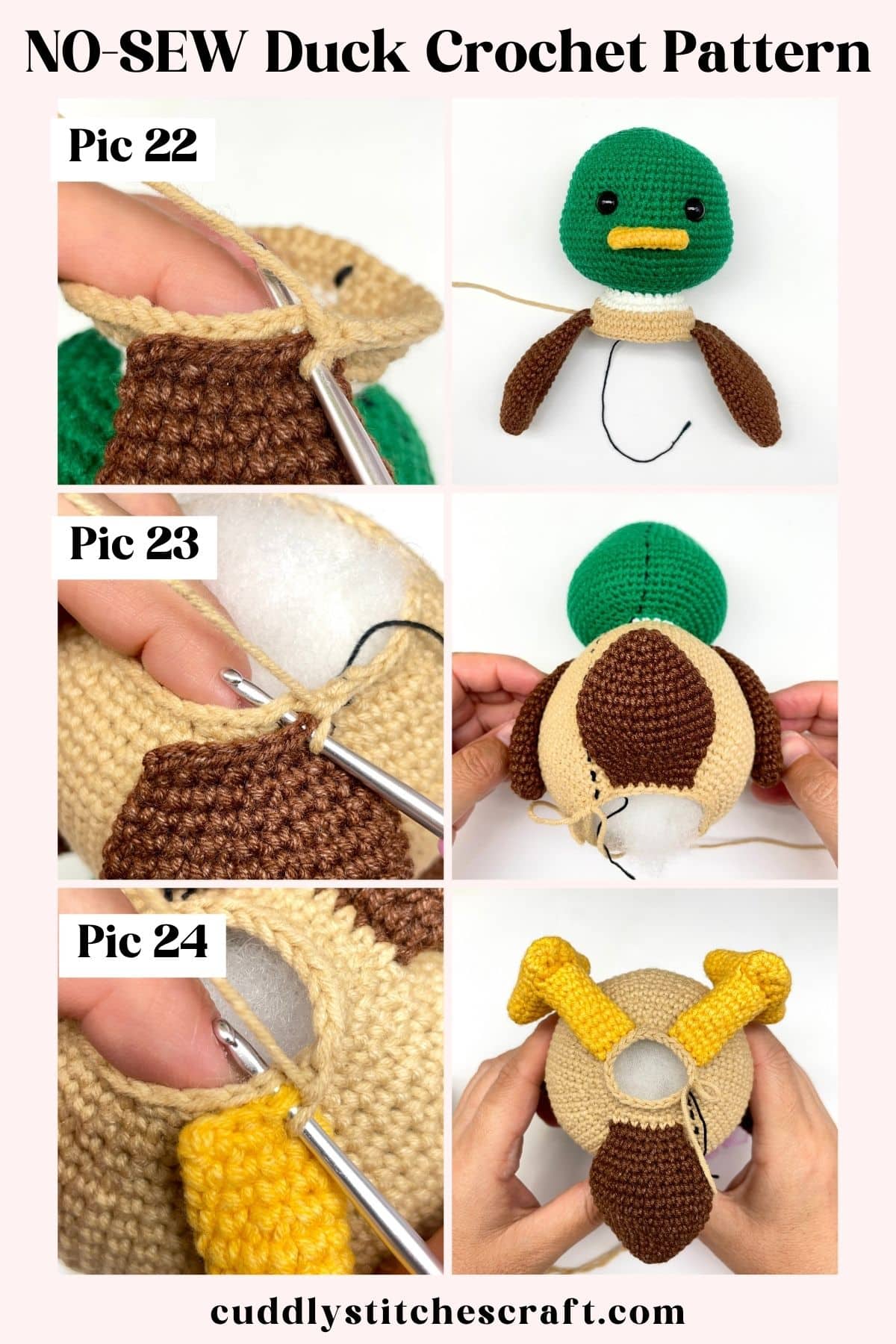
R34: you will attach the wings to the body in this round – watch this video tutorial on How to attach arms to your Amigurumi toy without sewing. In this video, I attach arms to the body but the technique is the same.
- SC in next 13 STs
- attach the first wing: SC in next 7 STs (Pic 22)
- SC in next 16 STs
- attach the second wing: SC in next 7 STs
- SC in next 5 STs {48}
Note: if the wings don’t line up neatly with the eyes and bill, you may need to move them one or two stitches to the right or left. This can happen due to variations in yarn tension or individual crochet technique.
R35: (SC in next 7 STs, INC) x 6 {54}
R36: SC in each ST around {54}
R37: SC in next 4 STs, INC, (SC in next 8 STs, INC) x 5, SC in next 4 STs {60}
R38-R39 (2 rounds): SC in each ST around {60}
R40: (SC in next 9 STs, INC) x 6 {66}
R41-R42 (2 rounds): SC in each ST around {66}
R43: SC in next 5 STs, INC, (SC in next 10 STs, INC) x 5, SC in next 5 STs {72}
R44-R49 (6 rounds): SC in each ST around {72}
R50: SC in next 5 STs, INV DEC, (SC in next 10 STs, INV DEC) x 5, SC in next 5 STs {66}
R51: (SC in next 9 STs, INV DEC) x 6 {60}
R52: SC in next 4 STs, INV DEC, (SC in next 8 STs, INV DEC) x 5, SC in next 4 STs {54}
R53: (SC in next 7 STs, INV DEC) x 6 {48}
R54: SC in each ST around {48}
You can now start stuffing the body
R55: SC in next 3 STs, INV DEC, (SC in next 6 STs, INV DEC) x 5, SC in next 3 STs {42}
R56: (SC in next 5 STs, INV DEC) x 6 {36}
R57: you will attach the tail to the body in this round using the same technique you used for attaching the wings
- SC in next ST
- attach the tail: SC in next 7 STs (Pic 23)
- SC in next 28 STs {36}
- don’t worry if the tail is floppy, you will fix this after finishing the body
Note: if the tail is not centred nicely between the wings, you may need to move it one or two stitches to the right or left. This can happen due to variations in yarn tension or individual crochet technique.
R58: SC in next 2 STs, INV DEC, (SC in next 4 STs, INV DEC) x 5, SC in next 2 STs {30}
R59: (SC in next 3 STs, INV DEC) x 6 {24}
R60: you will attach the legs to the body in this round using the same technique you used for attaching the wings. Ensure that when attaching the legs, the front of the foot is facing down.
- SC in next 11 STs
- attach the first leg: SC in next 4 STs (Pic 24)
- SC in next 3 STs
- attach the second leg: SC in next 4 STs
- SC in next 2 STs {24}
Note: if the legs don’t line up neatly with the wings and the tail is not centred between the legs, you may need to move them one or two stitches to the right or left. This can happen due to variations in yarn tension or individual crochet technique.
R61: SC in next ST, INV DEC, (SC in next 2 STs, INV DEC) x 5, SC in next ST {18}
R62: (SC in next ST, INV DEC) x 6 {12}
R63: SC in each ST around {12}
Stuff well, close the hole using a tapestry needle and use the yarn tail to fix the floppy tail as described below. Watch this video tutorial on How to Close Amigurumi: Ultimate Finish Tutorial
You can now fix the floppy tail by attaching the top of it to the body with two or three stitches using the yarn tail you have left after closing the body. I stitched R5 of the tail to R47 of the body but you can attach it as per your preference. You can then weave the yarn tail in.
Facial Features
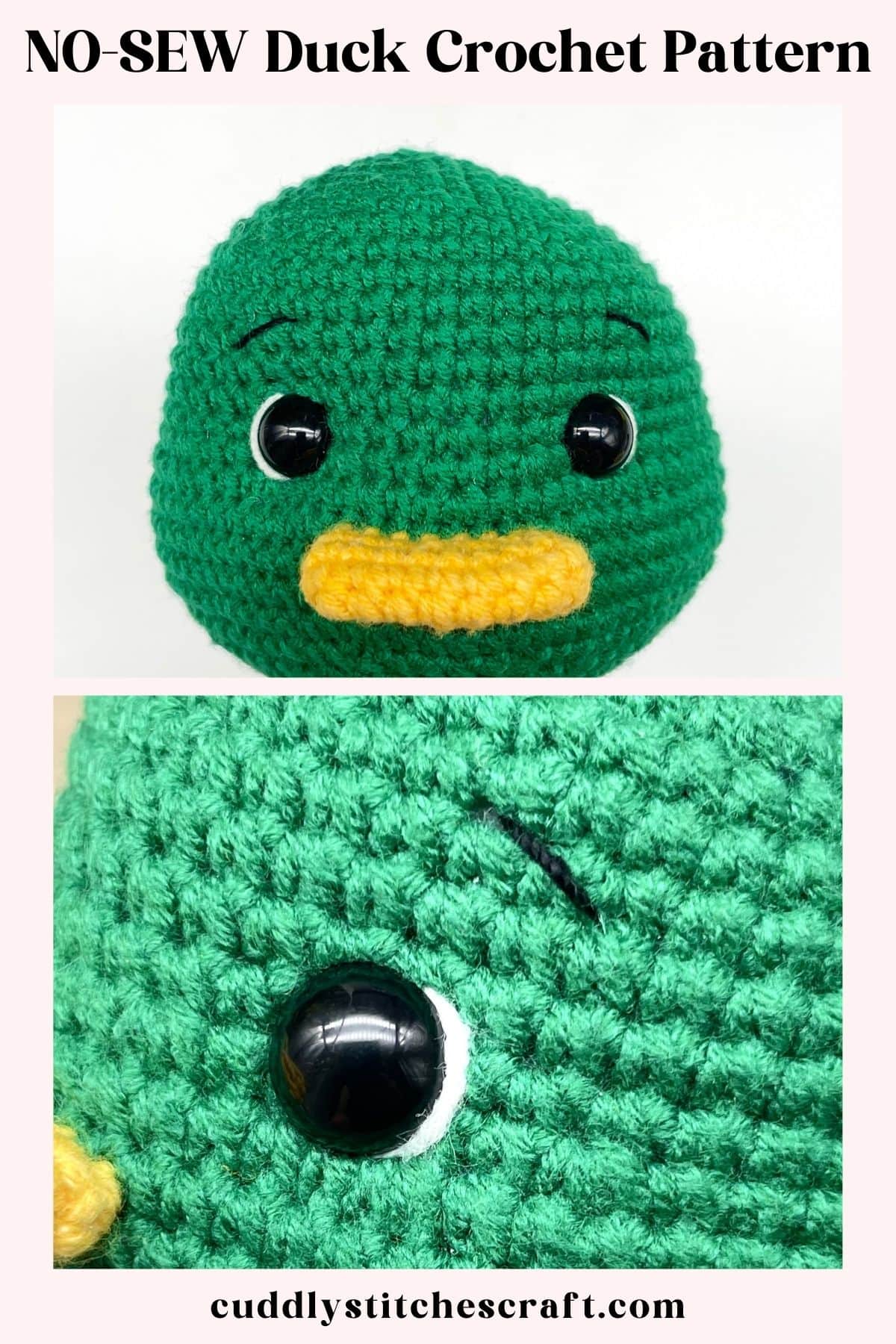
Eye brows: Embroider the eye brows using black thread embroidery yarn – about 30cm (12 inches). Mark the placement of the eye brows with pins first before you start embroidering. I embroidered the eye brows between R11 and R13 of the head; leaving 10 stitches between them. Watch this video tutorial on How to embroider nostrils on Amigurumi. It shows the same technique you can use for the eye brows too.
Eye detail around the eye: You can also embroider a nice detail around the eyes using white yarn (about 30cm /12 inches) as shown in the photos below.
Hair
Yarn color: green
Construction: create the hair by crocheting chain loops into the unworked front loops on the top of the head
Tip: if you find it difficult to insert your hook into the front loops then use a slightly smaller hook instead but you may need to crochet more chains (e.g. 16 instead of 14) otherwise the loops may be too short.
Step 1: insert your hook into the first unworked front loop stitch, wrap a new strand of yarn around it, pull it through the loop and chain 1x
Step 2: chain 14x and SL ST into the same FL ST – that’s your first loop created
Step 3: SL ST into the next FL ST, chain 14x and SL ST into the same FL ST – that’s your second loop created
Step 4: repeat the above step until you reach the end of the round with the unworked FL STs – you should have 6 loops of hair in total
Step 5: SL ST into the first unworked FL ST where you started and FO. Cut the yarn off.
Step 6: if you would like to close the little circle in the middle of the hair, you can pull the yarn tail through the bottom chains all the way round using a tapestry needle and then pull on the yarn tail tight to close it. Weave the yarn tails in.
Save 15% off all PDF patterns!
Sign up for my newsletter and receive a discount on all current and future patterns purchased on Etsy. Plus stay in the loop with updates on new designs, tutorials and special offers.
And you are done! 🙂 I hope you enjoyed making this no-sew crochet duck and that it brings plenty of smiles wherever it ends up. If you’d like to create a matching farmyard friend, be sure to pair it with my crochet chicken pattern to complete the flock.
And if you enjoyed how simple and straightforward the assembly process was, be sure to check out these crochet toy patterns:
Explore More of My Free Amigurumi Patterns
If you like this duck crochet pattern free, you may also love these patterns. Why don’t you give them a try?!
Free crochet cow pattern
Free crochet bunny lovey pattern
Free crochet dinosaur pattern
Or explore more of my crochet farm animals patterns and create adorable and fun farm animals that are sure to capture the hearts of all ages!
Happy crocheting!
Frequently Asked Questions
Have a question? Why don’t you search for the answer in the FAQ below.
Yes, absolutely. My crochet animal patterns work great with a variety of different yarns including worsted weight yarn. Your crochet toy will just be a bit bigger than specified.
However, I wouldn’t use worsted weight yarn for making my loveys as they could feel a bit bulky. I prefer using thinner yarn such as Sport yarn #2 of Light worsted yarn #3 for a nice cuddly feel.
Having said that, my lovey patterns will absolutely work with worsted weight yarn if that’s the type of yarn you prefer using. But bear in mind that your loveys will be a bit bigger than specified in this pattern.
To find out more about the best yarn for making crochet toys have a read of my Best Yarn for Amigurumi Crochet tutorial.
I am very happy to help and provide support with any of my patterns. Visit my Contact page for different options on how to get in touch with me.
I would be very grateful if you could link to my patterns and tutorials on social media. But sharing of my actual written patterns on social media is strictly prohibited. For more details, have a read of my Copyright Policy.
You may sell finished items that you made using my Amigurumi patterns, provided you credit me as the original designer and provide a link back to my blog.
My free patterns are only available online on my blog and are not printable. If you would like to download a PDF version of my patterns then you can purchase them for a small fee from my Etsy store or Ravelry store.


